

Queen Bees, Bee Packages, Beekeeping Equipment
New to Beekeeping? Start Here.
Welcome! This page will give you a clear, realistic picture of your first season—without overwhelming you or sugar-coating the work involved.
A colony is a living system that changes throughout the year. Learning the basics early will help you understand what you’re seeing, recognize problems, and make informed decisions.
Before we get into hive inspections, let’s cover what you need to get started. Each topic will be discussed in greater depth below.
What Do I Need?
Protective Gear & Tools
Start with a well-fitting bee suit or jacket with a veil, gloves, a smoker, and a hive tool.
Your protective gear should help you feel comfortable enough to work calmly. Keep in mind, check the sizing charts; suits tend to run small. The smoker helps manage the colony’s response during inspections, while the hive tool lets you separate boxes and frames that bees have sealed together.
Protective gear reduces sting exposure, but no setup guarantees you won’t be stung. There's more stuff out there; don't get lost in it. That's all you'll need to start.
A Hive & Feeding Equipment
You’ll need a complete hive with a bottom board, boxes, frames, and a suitable cover. Choose a system you can manage comfortably, with compatible equipment available when you need to expand.
Have additional boxes and frames ready before your colony outgrows its space. The amount of equipment you need will change as the colony develops and the seasons progress.
A reliable feeder is also important. New colonies may need supplemental feed while drawing comb and establishing food reserves, especially when natural forage is limited.
A Way to Monitor Varroa Mites
Mite monitoring belongs in your starting equipment—not on a list for later. Have a suitable sampling kit and learn how to use it, interpret the results, and plan any necessary treatment.
A colony can look busy and still have a serious mite problem.
Bees!
There are several ways to start a colony:
-
Nucleus hives, or nucs: Small, established colonies containing bees, a laying queen, brood, drawn comb, and food stores.
-
Packages: Bees supplied with a queen, typically introduced into your equipment without established brood or comb.
-
Swarms: Colonies collected after leaving another hive. Availability, size, queen status, and health can vary.
Each option has advantages and challenges. Consider the source, timing, colony condition, and support available—not just the purchase price.
Time & a Learning Plan
Your bees will need regular attention during the active season. Plan time for inspections, feeding when necessary, mite monitoring, and seasonal preparation.
A beginner course, experienced mentor, or local beekeeping association can help you connect what you read with what you see inside your own hive.


Which is Better? A Package or a Nucleus Hive

Nuc
A nucleus hive offers several advantages for beekeepers. Firstly, it provides a manageable colony that is perfect for beginners, or those looking to expand their apiary without overwhelming themselves. Secondly, nucleus hives are often a quicker way to establish a new colony, as they come with a queen and a mix of workers at all stages, with built-out comb, brood in multiple stages and resource frames. The colony starts 6-8 weeks ahead of a package because of these frames. Which in my opinion matter in Colorado seasons.

Package of bees
Starting with a package of bees can be a little better financially. A package of bees typically includes a queen and a mix of worker bees. I would suggest a package of bees for a bar style hive. You can also use a package of bees to bolster an existing hive. Just keep in mind the queens wont mix, so don't add both to the hive. I have personally used packages and seen success with them here in the Denver area.

Protective Gear
Protective Gear & Tools: Choosing What Works for You
You don’t need every gadget in the catalog. Start with equipment that fits well, lets you see clearly, and helps you handle the colony calmly.
Suits, Jackets & Gloves
A full suit provides more coverage, while a jacket paired with suitable pants can be more convenient. Ventilated designs can make hot-weather inspections more comfortable.
Choose light-colored clothing and a fit that allows you to bend, reach, and lift without pulling the material tight against your skin. Check the manufacturer’s measurements rather than relying on your usual clothing size.
Before each inspection, check zippers, seams, cuffs, and ankles for gaps. Gloves should provide protection without making it difficult to grip frames. Thick leather offers durability, while thinner gloves provide more dexterity but less sting protection.
Veil Types
Round veils use a brim or supporting structure to hold mesh away from your face and provide visibility around your head.
Fencing veils extend forward from the head and are commonly attached to jackets and suits. Check that the mesh stays away from your nose and chin when you bend over.
Separate hat-and-veil combinations offer flexibility, but their closures must seal properly around your clothing.
Whichever style you choose, prioritize clear vision, secure closures, and space between the mesh and your skin. Bees can sting through mesh resting against your face.
Hive Tool Types
Bees seal equipment with propolis and build wax between surfaces. A hive tool lets you separate those parts with controlled pressure.
Standard flat hive tools have a scraping edge and a bent end for prying boxes and loosening frames. They are simple, versatile tools for everyday inspections.
J-hook hive tools add a curved hook that helps lift a loosened frame using the neighboring frame as leverage. They can be especially useful when frames are tightly sealed in place.
Either style can get you started. Work slowly, loosen frames before lifting, and avoid crushing bees between moving surfaces.
Smoker Types & Features
Most traditional smokers use a metal fuel chamber and hand-operated bellows. The main differences are chamber size, materials, bellows construction, and heat protection.
Smaller smokers are compact and may suit short inspections, but generally need refueling sooner.
Larger smokers hold more fuel and can be useful when inspecting several colonies.
Look for a stable base, a lid that opens for cleaning, dependable bellows, and a wire heat guard. A heat guard reduces accidental contact with the hot chamber; it does not make the smoker safe to touch or place on combustible surfaces.
Aim for cool smoke with no flames, sparks, or hot embers coming from the spout. Use a few gentle puffs and give the bees time to respond. More smoke is not always better.
Fuel & Fire Precautions
Suitable fuels include clean, untreated burlap, dry pine needles, and untreated wood shavings. Avoid synthetic fabrics, treated wood, plastic, and fuel contaminated with chemicals.
Keep water and a noncombustible container nearby. Set the smoker on a fire-safe surface, fully extinguish the fuel after use, and let the equipment cool before transport.
Check the fire restrictions that apply to your exact apiary location before lighting a smoker. Do not assume beekeeping equipment is exempt.
A light sugar-water mist is sometimes used for limited bee handling, but it does not work like smoke and can attract robbing. If smoke cannot be used safely or legally, consider postponing nonessential inspections rather than relying on mist to manage a defensive colony.


What kind of Hive is Right for you?
There are more out there, we just want to cover the basics
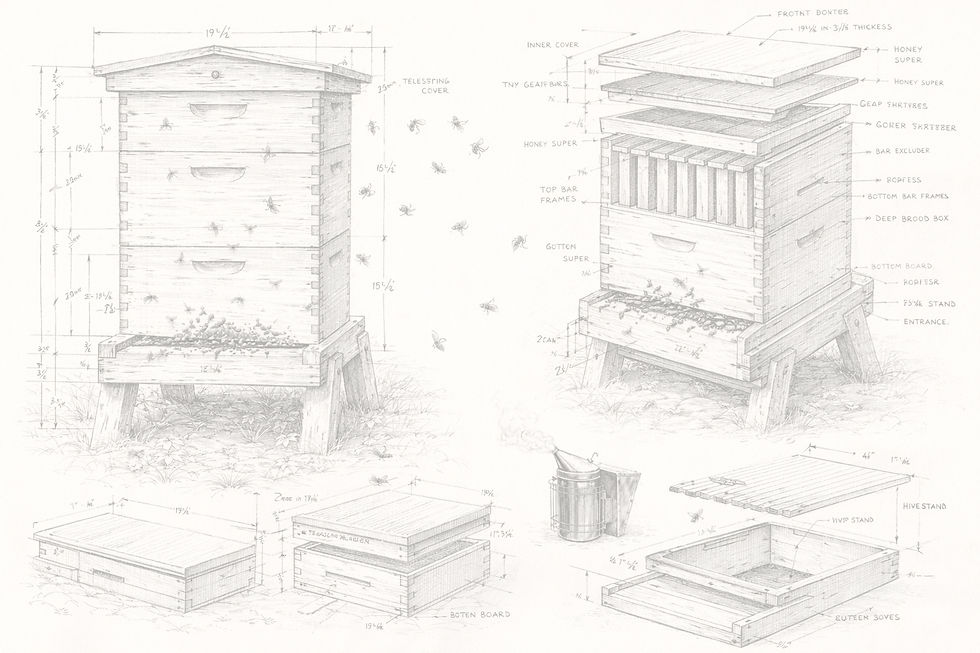
Langstroth Hive

Langstroth hives are a popular type of beehive that was designed by Reverend Lorenzo Langstroth in the mid-19th century. They feature removable frames that allow beekeepers to easily inspect and manage their colonies. One of the main advantages of Langstroth hives is the ability to choose between 8 and 10-frame configurations, with 8-frame hives being lighter and easier to handle, and 10-frame hives offer more for honey production. Additionally, Langstroth hives provide excellent overwintering capabilities thanks to their design that promotes better insulation and airflow, helping to keep the bees warm during colder months.
Top Bar Hive

Bar Hives offer several advantages for beekeeping enthusiasts. Allowing the bees to build their combs freely without the constraints of frames. Overall, they combine functionality with a bee-friendly approach to honey production. For this style hive I would recommend a package or a swarm.
Flo Hive

The Flow Hive is an innovative beekeeping system designed to make honey harvesting easier for beginners. This hive features specially designed frames that allow beekeepers to extract honey without disturbing the bees. Simply turn a lever, and honey flows out of the tap, making the process cleaner and more efficient. It's a great choice for those new to beekeeping, as it minimizes stress and equipment for both the bees and the beekeeper.
The Different Types of Bees in a Hive

Queen
The queen bee is the heart of the hive, primarily responsible for laying eggs and ensuring the colony's survival. She is typically the largest bee in the hive, recognizable by her elongated abdomen. Beyond her reproductive role, the queen also maintains harmony within the colony by releasing pheromones that regulate the behavior of the worker bees. This vital communication helps to keep the hive organized and thriving.

Workers
A worker bee is a female bee. They are responsible for a variety of tasks including foraging for nectar and pollen, caring for the queen and larvae, and maintaining the cleanliness of the hive. Worker bees are known for their incredible teamwork and communication skills, using dances and pheromones to share information. Their dedication and hard work contribute significantly to the survival and productivity of the entire colony.

Drones
A drone honey bee is a male bee whose primary role is to mate with a queen during the breeding season. Unlike worker bees, drones have larger bodies and distinctive big eyes, which help them spot queens from a distance. They do not gather nectar or pollen and are typically absent from the hive during winter months, as they do not survive the season. The drones sole purpose revolves around reproduction, ensuring the of the colony's lineage.


Should I Start with One Hive or Two?
You’ll often hear experienced beekeepers recommend starting with two hives instead of one. The reason isn’t luck — it’s flexibility.
Starting with One Nuc can make sense if:
-
This is your first hive
-
You want to learn inspections, brood patterns, and seasonal rhythm without feeling rushed
-
You have limited time or equipment this season
-
You’re comfortable learning slowly and deliberately
Many excellent beekeepers started with one hive and built from there.
With one hive, success comes from vigilance: regular inspections, timely feeding, and paying attention to what the bees are telling you. Nearly all of the “two-hive advantages” can still be achieved with help from a trusted friend, mentor, or local bee club.
Starting with Two Nucs gives you more tools:
Two hives doesn’t mean twice the work — they give you options.
With two nucs, you gain the ability to:
-
Swap hive locations mid-day to shift forager populations and rebalance work forces
-
Move brood from a strong hive to help a lagging one catch up
-
Balance honey and pollen stores between colonies when one is ahead of the other
-
Compare brood patterns, temperament, and growth side by side
-
Make calmer, more confident decisions because you have a reference point
These tools can make problem-solving easier, especially in a variable spring. This also comes with increased feed, treatment, work, and harvesting pressure. The trade offs are real.
A balanced way to think about it:
One hive teaches you what to look for.
Two hives teach you why something looks the way it does.
There’s no wrong answer here, just the right fit for where you are this season.
Still not sure?
Reach out anytime. We're happy to talk to you beekeeper to beekeeper. Not a sales call, just a conversation.
Sometimes a five-minute conversation saves a season of frustration.
Would you like us to install your hive for you?
Free online Beekeeping course
Would like an in person class?

Types of Brood
(Baby Bees)


Egg
From being laid - 3 Days
The egg stage of the honey bee is a critical first phase in its life cycle. During this stage, the queen bee lays fertil eggs within the honeycomb cells, which are the size of a grain of rice. These eggs are, oval-shaped, and are typically laid one per cell. After approximately three days, eggs hatch into larvae, marking the transition to the next stage of development.

Larva
3 - 6 Days
Honey bee larvae are tiny, white, and worm-like creatures that emerge from eggs laid by the Queen bee. During this stage, they are fed a nutritious diet of royal jelly, which helps them grow rapidly. Over the course of about three days, they will develop into pupae. Nutrition at the larval stage is crucial for their development, as they undergo significant changes that prepare them their future roles within the colony.

Pupa
6 - 21 Days
The pupa state of the honey bee is a fascinating stage in its life cycle, occurring after the larval phase. During this time, the bee is encased in a protective cocoon within the honeycomb undergoing significant transformation. The pupa is immobile and relies on the warmth of the hive to develop, as it gradually develops into its adult form. This stage lasts for several days, after which the fully formed bee emerges, ready to take on its role within the colony.


Worker Lifecycle

Nurse
Birth - 3 Weeks
Nurse Bees play a crucial role in the hive by tending to the queen and the brood. They are responsible for feeding and caring for the larvae and new queens, ensuring that the next generation thrives. Their attentive care is vital for the hive's health and productivity, as they nurture and support the colony's growth and development. Through their dedicated efforts, Nurse Bees help maintain a strong and flourishing beehive.

Guard
3 - 6 Weeks
Guard bees play a crucial role in protecting the entrance of the hive from various threats, including bugs, other bees, crit, and even humans. When you hear a bee angrily zoom by or feel one bump against your veil, that's a guard bee diligently doing its job. To minimize defensive reactions, it's important to clean your suit regularly, as old bee venom can trigger their instincts. Keeping your gear fresh helps ensure a safer and more harmonious experience these vital pollinators.

Worker
6 Weeks - Death
Worker bees are the hives primary foragers and caretakers. They are responsible for collecting pollen and nectar, which they convert into honey, while also tending to the queen and the brood. Remarkably, these industrious bees travel up to 2.3 miles from their hive in search of food sources, showcasing their dedication to the colony's survival. Their hard work and teamwork are essential for maintaining a healthy thriving hive. The waggle dance is how they show where pollen and nectar flows are to other workers.


How Often Should You Inspect a Hive?
For most first-year beekeepers, inspections should happen about once every two weeks during the active season. There is a fine balance between too many inspections and not enough.
More frequent inspections (We call that petting your bees):
-
Stresses the colony and squishes more bees than necessary.
-
Rolling a queen can create an expensive problem to remedy. When a queen dies, you lose both time and money.
-
Disrupts brood temperature.
-
Does more harm than good.
Less frequent inspections:
-
Allows for problems (like queen failure, swarming, sickness, or mites) to go unnoticed.
Consistency in the way your hive looks matters more than frequency.
Every inspection should answer a few simple questions:
-
Is the queen present or laying?
Evidence that the queen is working is almost as good as seeing her. Eggs and young larvae mean she’s doing her job. If you find them, ask yourself how old are they? -
Is there healthy brood?
Look for a solid brood pattern without excessive gaps (or holes in the middle of capped brood). -
Do they have food?
Nectar/honey stores and pollen are both critical. See below to dive into the differences between the two. -
Is there room to grow?
Crowded hives lead to swarming.
Remember, this isn't about perfection, you're looking for trends.
If you would like our 5280 inspection checklist Click Here.
Printing off a few to track trends can help.
Pollen vs. Honey; Why Both Matter
-
Honey (or nectar) is energy in the form of carbohydrates.
-
Pollen is protein, otherwise known as bee bread.
Honey fuels daily activity, Flight, and Warmth.
Pollen fuels brood production.
If pollen is lacking, brood slows - even if honey is abundant. If honey is lacking, starvation occurs - even if pollen is abundant. This is why supplemental feeding is sometimes necessary early in the season, or if a hive is just starting out. Rome wasn't built in a day, and in this game of thrones a hive isn't either.
So always keep extra sugar to make 1:1 and 2:1 syrup to feed nectar, and a good pollen patty or two. I keep the pollen patties in the freezer to keep them fresh. they can either be purchased or made. Recipe below.
1:1 syrup is 1 part by weight sugar and 1 part by weight water.
2:1 syrup is 2 parts sugar and 1 part water. Heat can help dissolve sugar but bee careful. Never put an acid in a hot sugar mix as it will kill the bees.
If there were terms that you didn't quite understand? No worries, we have you covered Beekeepers Dictionary of terms Here
Pollen Patty Recipe Here


Here at 5280 Apiaries, we understand that beekeeping is an investment both financially and with time; and that it comes with plenty of learning, research, and a few mistakes along the way.
If you ever have questions, don’t hesitate to call or text. Beekeeping can feel overwhelming at times (especially in the beginning) and you’re not expected to figure it all out alone. We’re here to help every step of the way.
We also highly recommend joining a local bee club. It’s a great place to find resources, ask questions, and connect with others who share an appreciation for the beautiful insects that makes the nectar of the gods.