

Queen Bees, Bee Packages, Beekeeping Equipment
Beekeeper’s Dictionary
A Plain-Language Guide to Beekeeping Terms, Slang, and Shop Talk
Beekeeping comes with its own language. Some of it is scientific, some of it comes from long-standing tradition, and some of it is simply shorthand that beekeepers use when talking shop.
This guide breaks down common beekeeping terms in plain English and adds context for when—and why—you’ll hear them used in the field. The definitions here are drawn from real, hands-on experience, not just textbooks. It’s not meant to be all-inclusive or definitive, but rather a practical reference to help new and experienced beekeepers speak the same language and better understand what’s happening inside their hives.
You don’t need to memorize all of this
Most beekeeping knowledge comes from patterns, repetition, and asking questions. If someone uses a term you don’t recognize — ask. Every experienced beekeeper was new once. If you would like a term to add to the list we would love to hear it!
If you ever need clarification, call or text. We’re here to help you learn without making expensive mistakes.
Bee Anatomy & Biology
Abdomen
The rear section of a bee’s body. It houses the honey stomach, digestive system, sting, and reproductive organs.
Proboscis
The bee’s tongue. Used to suck up nectar, water, and syrup.
Wax Glands
Glands on the underside of worker bees that produce beeswax for comb building
Honey Stomach
A storage organ used to transport nectar, honey, or water — not the same as the digestive stomach.
Castes & Bee Roles
Queen
The reproductive female of the colony. Her main job is laying eggs and producing pheromones that keep the hive functioning as a unit.
Virgin Queen
An unmated queen. She runs fast, pipes loudly, and hasn’t started laying yet. The Virgin Queen flies out of the nest to mate out 5-14 days after emerging. The mating process lasts 10-30 minutes.
Fertile / Mated Queen
A queen that has successfully mated and can lay fertilized eggs (workers).
Breeder Queen
A queen selected for desirable traits (temperament, productivity, overwintering ability, disease resistance) and used to produce future queens.
Worker Bee
A non-reproductive female that does all hive labor: nursing, foraging, cleaning, guarding, and temperature regulation.
Drone
A male bee whose only biological purpose is mating with queens. Drones don’t sting or forage.
Laying Worker
A worker bee or many laying unfertilized eggs (drones only), usually in hopelessly queenless colonies.
Brood & Lifecycle
Egg
Laid by the queen. Looks like a tiny grain of rice standing upright in a cell.
Larva
The grub stage after the egg hatches. Fed heavily by nurse bees.
Pupa
The transformation stage between larva and adult bee.
Brood
Unhatched developing bees: eggs, larvae, and pupae.
Capped / Sealed Brood
Cells sealed with wax while bees develop inside.
Open Brood
Eggs and larvae that haven’t been capped yet.
Spotty Brood
An uneven brood pattern with empty cells scattered throughout. Can indicate queen issues, mites, disease, or nutritional stress.
Chilled Brood
Brood killed by exposure to cold, often due to over-inspection or weak colonies.
Hive Equipment & Structure
Hive / Beehive
A man-made home for bees using movable frames.
Hive Body
The wooden box that holds frames.
Deep
A tall hive body usually used for brood.
Super
Any hive body placed above the brood nest for honey storage.
Frame
A removable structure that holds comb.
Foundation
Wax or plastic base that bees build comb on.
Drawn Comb
Foundation that bees have already built out with wax. This is now ready to be filled with nectar, honey or pollen this is an extremely valuable asset for the hive.
Bottom Board
The floor of the hive.
Hive Entrance
Typically created by elevated sides on the bottom board. The hive entrance is where worker bees leave the hive to collect resources. this is also where you will find debris pushed out of the hive from bees cleaning their space.
Inner Cover
A lightweight cover under the outer lid. The purpose of this is to be able to easily remove the lid with propolis and burr comb build up.
Queen Excluder
A grid that allows workers through but keeps queens and drones out of honey supers or away from areas she is not wanted in.
Handling & Inspections
Rolling the Queen
Accidentally crushing the queen between frames or boxes during inspections. Slow movements save queens.
Petting Your Bees
Slang for inspecting too often. Too much inspection causes stress and mistakes.
Bee Space
The ¼–⅜ inch gap bees naturally respect without filling with comb or propolis so that they can move freely in the hive.
Bee Way
The area of flight path of bees entering and exiting the beehive.
Brace Comb / Burr Comb
Extra comb built where it shouldn’t be. Usually a sign of spacing issues.
Drifting
Bees entering the wrong hive, common in larger apiaries.
Smoke & Behavior
Smoker
A device producing cool smoke to calm bees during inspections.
Rolling Smoke
Applying steady, gentle smoke — not blasting the hive.
Hot Hive
A colony that is unusually defensive or aggressive. Hives are a lot like people at times; sometimes they can just be grumpy. So you have to treat them like a teen girl. Are they fed? check for pollen and nectar/honey, are they feeling okay, how's their queen, did something disturb them previously. If so a bees memory lasts for about 3 days. Fix what you can and give them some time
Queen Piping
High-pitched sounds made by queens, often during swarming, caged queens or supersedure.

Orientation Flights
Orientation flights taken by young bees, the new bees will fly in a figure 8 in small waves. often mistaken for swarming. This is due to a large hatch and can vary in size. This is a sign of growth in the hive.
Feeding & Foraging
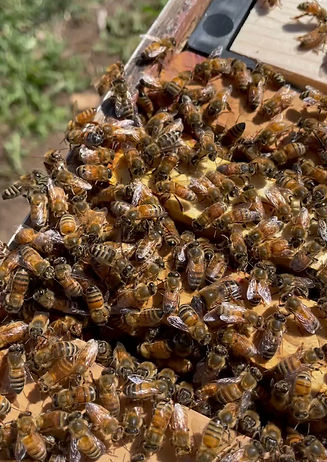
The Waggle Dance
The waggle dance is a communication behavior used by honey bees to share the location of food sources.
A forager bee performs a figure-eight movement inside the hive. During the straight “waggle run,” the angle of the bee’s movement relative to gravity indicates the direction of the food source in relation to the sun, while the duration of the waggle conveys the distance. Other bees follow the dance, sensing movement and vibrations, and use this information to locate the resource.

Nectar
Sugary liquid collected from flowers.
Honey
Processed nectar stored by bees as energy.
Propolis
Propolis is a sticky, resin-like substance that honey bees collect from tree buds, sap flows, and other plant sources.
Bees mix these resins with wax and enzymes to create propolis, which they use to seal cracks, reinforce the hive, reduce drafts, and block pests. It also has strong antimicrobial and antifungal properties, helping protect the colony from disease.
Often called “bee glue,” propolis plays a key role in maintaining hive health and stability.
Dearth
A time of nectar and pollen scarcity.
Sugar Syrup
Artificial nectar substitute.
-
1:1 – Spring stimulation 1 part sugar 1 part water by weight.
-
2:1 – Fall storage 2 part sugar 1 part water by weight.
Pollen
Protein source for brood production.
Pollen Pants
Slang for the colorful pollen loads on a bee’s hind legs — a good sign brood will be present soon.

Bee Bread
Fermented pollen stored in cells for brood food.
Swarming & Colony Management
Swarm
When part of the colony leaves with the old queen to start a new hive. This is usually due to a large nectar flow And lack of space
Swarm Cells
Swarm cells are created when a colony becomes overcrowded and prepares to swarm. The old queen leaves with part of the colony to establish a new hive, while one of the newly raised queens remains to lead the original colony. Bees usually produce several swarm cells at once, and the strongest queen ultimately takes over brood production.
Beekeepers often find three or more swarm cells of different ages, typically built along the edges of the comb.
It’s normal to see multiple queen cells of any type. Bees may raise up to ten queens to ensure at least one strong, healthy queen survives.

Prime Swarm
The first swarm to leave, usually with the old queen.
After swarm
Smaller follow-up swarms, often led by virgin queens.
Absconding
When an entire colony abandons the hive due to stress, disease, or pests.
Supersedure
When bees replace a failing queen without swarming.
Demaree Method
a beekeeping technique used to prevent swarming by separating the queen and forager bees from the nurse bees and brood. This method involves rearranging the hive using a queen excluder, allowing the colony to maintain its population and honey production while managing the swarming impulse.

Health, Pests & Disease
Varroa Mites
Varroa destructor is a parasitic mite that infests honey bee colonies. The mite reproduces in brood cells and feeds on developing larvae, pupae, and adult bees, which weakens individuals and shortens their lifespan. Varroa also spreads several viruses that negatively affect bee health.
High mite levels are strongly associated with colony decline, reduced foraging success, and increased winter losses. Colonies with heavy infestations often experience lower populations in subsequent seasons.
Susceptibility to Varroa varies by bee genetics and environment. In some tropical regions, particularly where Africanized honey bees are present, mite levels tend to remain lower due to climate and host adaptation.
Mite Wash
A mite wash is a method beekeepers use to measure Varroa mite infestation levels in a honey bee colony.
It involves collecting a small sample of adult bees (usually about 300 bees) from a brood frame and agitating them in a liquid—such as alcohol, soapy water, or powdered sugar—to dislodge Varroa mites from the bees. The mites are then counted and compared to the number of bees in the sample to calculate a mite percentage.
Mite washes are considered the most accurate way to determine when treatment is needed, helping beekeepers manage Varroa before colonies suffer damage or collapse. Co2 can be used to "knock out the bees" but veiws on survival and effectiveness is mixed.

Mite Load
The level of mite infestation, must be measured, not guessed. A more in-depth look Here.
American Foulbrood (AFB)
A deadly bacterial brood disease caused by Paenibacillus larvae. Highly regulated.
European Foulbrood (EFB)
A bacterial brood disease affecting larvae.

Nosema
A gut parasite affecting adult bees. This causes Diarrhea, two types.
Sacbrood
A viral brood disease.
Wax Moth
A pest that destroys comb, especially in weak colonies or stored equipment.
Deadout
A colony that didn’t survive winter. Dead Colony Forensics article Here
For a more comprehensive look a disease in bees Click Here
Honey Processing & Equipment
Uncapping Knife
Used to remove wax caps before extracting honey.
Extractor
A machine that spins honey out of comb.
Comb Honey
Honey sold still in the comb.
Creamed Honey
Honey crystallized in a controlled way to create a smooth texture.
Granulation
Natural crystallization of honey — not spoilage.
Fermentation
Spoilage caused by excess moisture in honey and yeast in syrup.
Safety & Humans
We do not claim to be medical professionals, these are basic definitions to raise awareness and allow you to better discern what is happening. Please consult a professional if you feel any of these are happening to rule out any life threatening reactions.
Venom Allergy
Abnormal reaction to stings; ranges from mild to life-threatening.
Anaphylactic Shock
Severe allergic reaction that causes your airway to close. Anaphylaxis is a medical emergency. Call 911 immediately. I personally carry Benadryl, which cab assist or may help with minor allergic symptoms while waiting for help, but it does not replace emergency treatment.